Meet Grant
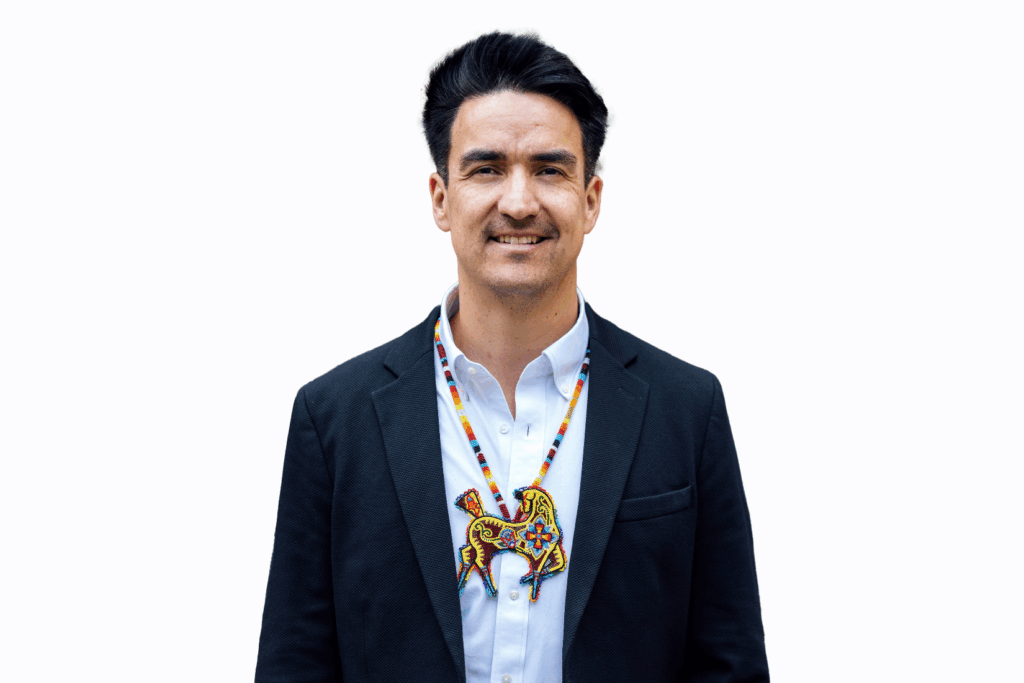
Assistant professor of the Department of Pediatrics and member of Samson Cree Nation, Grant Bruno is the academic lead for Indigenous Child Health with the Women and Children’s Health Research Insitute (WCHRI) and the Ispimihk Awâsisak Program.
Grant Bruno has spent a decade focusing on improving the health and well-being of Indigenous children, youth and families. As a nêhiyaw (Plains Cree) scholar, he’s led research that brings together Indigenous knowledge systems, ceremony and land-based practices with Western health sciences. His research is community-driven and done in partnership with Nations like Maskwacîs, where they co-design culturally grounded approaches to child health, neurodiversity (including autism) and caregiving.
In his free time, Grant is passionate about being on the land as it’s central to who he is as nêhiyaw. He enjoys hunting, medicine picking, or going for walks and sharing these experiences with his family and community. The land is an essential site of learning where cultural knowledge is practiced, transferred and lived. It reminds him that research must remain accountable to the land, kinship and to future generations.
Let’s find out more about Grant and his research:
What interests you most about your field of research?
The opportunity to create transformative change both personally and professionally. Working in Indigenous child health and neurodiversity allows me to bring together my personal experience as a parent, my nêhiyaw (Plains Cree) identity and my academic training to build systems that reflect the realities and strengths of our communities. I am especially interested in how Indigenous knowledge can shape approaches to health and well-being in ways that Western systems alone cannot. This field allows me to explore new ways of doing research that honour sovereignty, resist extractive practices and are grounded in reciprocity. What excites me most is seeing how these approaches empower Indigenous youth and families, affirm cultural identity and open new pathways for thriving futures.
How do you think your research will help inform future Stollery (and community) physicians and how might it impact future practices?
The research I do can make a difference for Stollery and community physicians by deepening their understanding of the realities and strengths unique to Indigenous children and families. By centering Indigenous worldviews, ceremony and land-based practices, I highlight approaches to care that are safer, more relational and responsive to our lives. This means physicians become better partners in care and the ability to build trust, respect family and community priorities – and understand how language, culture and identity shape every health outcome.
What are you most proud of when it comes to your research?
I am proud of advancing research environments where Indigenous knowledge, rooted in ceremony, language, kinship and land are not peripheral additions but central foundations of inquiry and practice. Positioning these knowledge systems at the core of research challenges the dominance of colonial models of health and biomedical science, while simultaneously generating innovative pathways for reimagining care and knowledge production. Most importantly, I take pride in contributing to a future in which Indigenous children and youth can see their identities, cultural practices and inherent strengths meaningfully reflected within health systems, affirming their value and fostering more equitable and culturally resonant models of care.
Do you have a personal connection to the Stollery?
As a parent, I have taken my children to the Stollery for care, and I have experienced firsthand the importance of having a specialized pediatric hospital that serves families across Alberta and beyond. This personal connection gives me an appreciation not only for the clinical expertise of the Stollery, but also for the need to ensure that care environments are welcoming, culturally safe and responsive to the diverse communities they serve.
What is your favourite kids’ book?
Awâsis and the World-Famous Bannock written by Dallas Hunt tells the story of Awâsis, a young Cree girl who sets out to deliver bannock to a relative but accidentally drops it along the way. Instead of giving up, Awâsis turns to the land and the beings around her – animal helpers like the bear, fox and other forest friends – who each contribute something to help her make a new batch.
Do you have a favourite Disney princess or superhero?
Moana. Her journey is about identity, courage and reconnecting with her people’s traditions of navigation and relationship to the ocean. I see strong parallels with Indigenous ways of being, returning to teachings, listening to ancestors and carrying knowledge forward for future generations. A bonus is that Moana is my daughter’s favourite!
Thanks to your support, researchers like Grant are a making a life-changing difference for the kids and families who rely on the Stollery’s care. You can continue to support world-class research by donating today.
Donate now